Introduction
Finding the right online platform for manufacturing services such as Xometry and Fictiv among others, poses a major problem for the engineer or procurement manager. The problem that emerges stems from being able to tell the real difference in cost structures of the services that seem the same at first glance. Comparison of these services manually takes much time, and the outcome may not always be clear, due to the vast differences in pricing models, procedures, and costs that underlie them.
This analysis focuses on five representative online sheet metal fabrication quote providers in 2026. It provides a horizontal analysis from the dimensions of cost drivers, quotation technology, and process optimization, offering a decision-making framework for evaluating and securing a precise accurate manufacturing quote online. Understanding the core differences between these top platforms is the first step toward an informed procurement decision.
How Do the Core Cost Drivers for 2026’s Top 5 Sheet Metal Quotation Platforms Differ?
When evaluating sheet metal fabrication cost, the composition of the custom sheet metal cost is key. The five major platforms emphasize different cost components based on their business models.
For platform-based service providers such as Xometry and Fictiv, huge global or regional networks of suppliers are aggregated to provide diverse capabilities. Although flexible, the pricing model may become complicated because there might be additional platform fees involved. The end price will greatly depend on the actual capacity and material stock at the winning supplier’s location, meaning that the markup for materials or different tolerance levels will not be explicit.
On the other hand, service providers that vertically integrate themselves or control all critical aspects of their manufacturing process such as Star Rapid and RapidDirect may prove to be more cost-transparent. They usually maintain relatively steady prices for volumes, have more transparent Minimum Order Quantity policies, and conduct first-article inspections as part of the standard quotation. In addition, providers such as LS Manufacturing, whose services are provided within their smart factory ecosystem, can guarantee cost breakdown accuracy right from the beginning.Their model focuses on streamlining the entire workflow from quote to delivery, potentially offering more predictable pricing for complex projects by eliminating intermediary layers. Essentially, platform models win on breadth and flexibility, while integrated models win on depth, control, and predictable custom sheet metal cost.
Why Do the Instant Quote Experiences and Logic of Xometry and Fictiv Differ?
Users seeking an accurate manufacturing quote online will notice that even though both promise instant quotes, the experience and logic behind get fabrication quote online at Xometry and Fictiv are distinctly different, stemming from their underlying technological approaches.
Xometry‘s quotation engine functions as an AI-driven global manufacturing marketplace. It synthesizes historical quote, capacity, and material data from its supplier network to generate an estimate based on market averages. Its strength lies in covering an extremely wide range of processes and materials almost instantly, but this quote may be subject to fine-tuning based on final factory matching.
Fictiv emphasizes end-to-end control and visibility of its digitally managed supply chain. Its quotes are more focused on its vetted, core partner network, offering higher certainty regarding production scheduling and cost prediction, balancing speed with determinism. Meanwhile, engineering-driven platforms may combine automated calculation with rapid human engineering review. Their response might be slightly slower than a fully automated system, but the quote is accompanied by preliminary manufacturability insights, offering deeper post-quote engineering support. This difference fundamentally reflects the contrasting logics of distributed market matching versus digitally managed production at the quotation stage. Companies focused on integrated development, like LS Manufacturing, often prioritize this latter approach, ensuring that the initial online sheet metal quote is backed by immediate expert review for complex parts.
Smart Nesting Algorithms: Among the Top 5 Platforms, Who Really Pays for Your Material Waste?
In any sheet metal fabrication service, material cost can constitute 30%-50% of the total, making material utilization a critical cost lever. The optimization capabilities of the five platforms in this area vary significantly.
The Limitations of Distributed Networks
In the distributed manufacturing networks of Xometry or Fictiv, an order is ultimately produced by a specific factory within the network. Material optimization depends heavily on that individual factory’s nesting software, sheet stock inventory, and production schedule. This creates siloed optimization, making it difficult to achieve cross-order, maximized use of full sheets. The cost of material waste is ultimately passed on to the customer, with inherent unpredictability.
The Systematic Advantage of Integrated Manufacturing
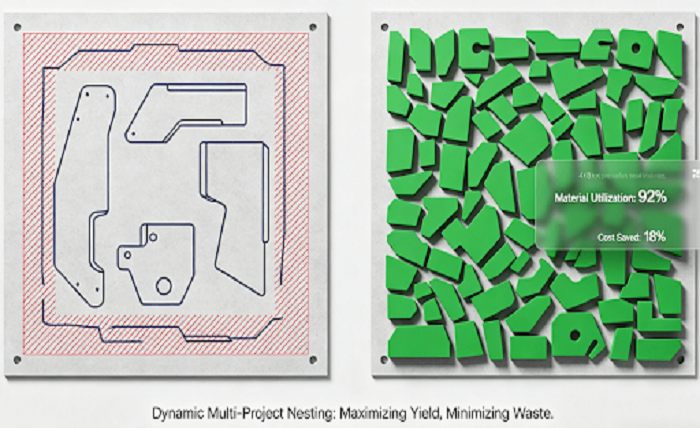
Service providers with large, integrated factory facilities, such as LS Manufacturing, can achieve a breakthrough. Their intelligent nesting software can perform dynamic nesting of parts from different customers and projects within a unified system, akin to a complex puzzle.
- The Principle of Cross-Project Optimization
The system can nest small parts from Project A with larger parts from Project B on the same standard sheet, filling blank areas to systematically increase material utilization from an industry average of 70-75% to 88% or higher.
- Cost Impact and Quotation Reflection
This systematic saving directly reduces the raw sheet cost per part. Therefore, when evaluating quotes, a provider capable of such deep process optimization may offer more competitive foundational costs. For a detailed analysis of how intelligent algorithms impact the final price, refer to this in-depth discussion on sheet metal fabrication quote.
Optimization Capability as a Core Competence
Leading service providers are increasingly positioning smart nesting and process simulation software capabilities as core differentiators, reflecting their value directly in quotation competitiveness. Choosing a platform is not just about selecting a vendor, but also about accessing the hidden cost savings enabled by their technology stack.
Online DFM Analysis: How Do the Top 5 Platforms Help Engineers Save Money Upfront?
A superior online sheet metal quote tool’s value extends far beyond providing a price. Its true worth lies in delivering deep, actionable Design for Manufacturability (DFM) feedback through its sheet metal quote calculator, controlling costs at the source.
Basic platform DFM checks might be limited to rule-based prompts like hole too close to edge or bend radius unsuitable for material. Advanced platforms, however, provide quantified cost-impact analysis. For instance, the expert review or automated manufacturability reports from providers like LS Manufacturing not only identify issues but also offer specific optimization suggestions: Changing this feature from welding to a single bend could save ~15% in cost and shorten lead time by 2 days.
Such in-depth engineering-based feedback allows for the transformation of the quotation procedure from a request and compare process to optimization. The engineers will be able to see the direct effect on the costs and schedule that different choices in the design, such as closer tolerances and features, have early in the design process.This capability is becoming a key differentiator in platform value, enabling true upfront savings. In 2026, a quote without deep DFM insights is likely incomplete, if not misleading.
Facing High-Precision Medical Components, Which of the Top 5 Can Provide a Credible Precision Sheet Metal Cost?
When a project involves high-stakes fields like medical devices or aerospace, a basic precision sheet metal cost figure is insufficient. A credible custom sheet metal cost must reflect the systemic costs of guaranteeing quality and traceability.
Transparency of Capabilities and Credentials
First, does the platform clearly demonstrate its capability for high-precision applications? This includes: support for certified special materials like implant-grade 316L stainless steel; transparency about stable process capabilities for tolerances of ±0.05mm or tighter; and, crucially, the completeness and transparency of quality system certifications (e.g., ISO 13485 for medical, AS9100D for aerospace). Suppliers holding top-tier industry certifications like IATF 16949 or AS9100D have management systems that inherently constitute part of the cost structure.
Decomposing the Cost of Reliability
For critical components, a trustworthy quote must include the cost of reliability.
- Process Control and Inspection Costs
This encompasses all labor, equipment, and time costs arising from material incoming inspection, comprehensive First Article Inspection (FAI), in-process Statistical Process Control (SPC), and full dimensional reporting (FAIR) before shipment. A quote vaguely stating inspection included differs fundamentally from one specifying provides AS9102-compliant first article report in its underlying cost and reliability.
- Documentation and Traceability Costs
Rigorous document control and full product lifecycle traceability are mandatory for medical and aerospace projects. The quote should reflect the administrative costs incurred to ensure this compliance. Providers equipped for such projects offer sheet metal fabrication services that cover the entire workflow from material certification to final inspection.
The Platform Model Challenge and the Choice
In a platform model, ensuring every potential supplier in the network possesses equal levels of certification and process stability is a significant challenge. Therefore, for high-precision medical components, choosing a vertically integrated service provider that fully controls the core process chain internally and holds the relevant top certifications is often the best path to a credible, transparent, and risk-controlled precision sheet metal cost. Their quote is, in itself, a commitment to quality and reliability. Partners like LS Manufacturing, with in-house ISO 13485 and IATF 16949 certifications, build this assurance directly into their manufacturing and quoting process.
Conclusion
Sheet metal fabrication cost management in 2026 is an elaborate competition comprising transparency of information, processes know-how, and resilience of the supply chain. The horizontal comparison of top providers such as Xometry, Fictiv, Star Rapid, and RapidDirect has made clear that the real cost competitive advantage is not simply a faster quote, but the ability to achieve cost savings through efficient and sophisticated algorithms of DFM support and quality control.
One should take care to assess the partner not only by its quotes and final prices. It is important to examine how effectively their technology stack can save you additional money, and whether their certificates and qualifications, for instance, ISO 13485, AS9100D, and IATF 16949, meet your industry needs.
Author Bio
The author is an independent analyst in manufacturing supply chain and digital procurement, with long-term tracking of global online manufacturing platform trends. Dedicated to helping R&D and procurement teams optimize supplier selection and cost control through data-driven comparative research.
FAQs
Q1: Of these leading platforms, which one do you think is more economical in terms of providing small batch prototypes?
A1: Platforms with good engineering support teams and fast responses (like Star Rapid, Fictiv) would have better chances to communicate with the customer and optimize their designs, hence avoiding additional costs from potential design problems. This means even if the unit cost isn’t the lowest, they are more cost-effective in the long run.
Q2: When my design consists of several processes (sheet metal + CNC + surface treatment), which one should I use?
A2: The better option would be platforms providing one-stop manufacturing solutions for such complex parts. They can arrange the entire process within their factory to ensure seamless communication, delivery, and quality.
Q3: What is the best way to determine if an online quote covers all possible fees?
A3: Make sure to thoroughly examine the breakdown of the quotation. It should state the costs for material, manufacturing, set-up or tooling, surface treatment, total inspection or first article inspection, packaging, and delivery. However, the best approach would be to communicate directly with a sales engineer and ask, Besides this quoted price, what other fees might occur?
Q4: How do the platforms manage international logistics and tariffs?
A4: Many reputable platforms provide the choice of DDP quotation. This means that besides the quoted price, you pay for all transportation costs, insurance, and duties at the destination. Your products are delivered right to your address, and you need not worry about custom procedures.
Q5: How do you resolve quality disputes on these online marketplaces?
A5: Legitimate marketplaces offer quality dispute resolution mechanisms (often detailed in their terms and conditions). Usually, one has to file a complaint during a stipulated time frame after delivery, supporting the claim with photographic or video proof and/or an independent inspection report. Online marketplaces with an established quality management system (such as ISO 9001) and those issuing COC/FAIR inspection reports tend to be more effective in handling disputes and liability issues.